Mission LiFE: How Citizens Can Contribute to India’s Sustainable Lifestyle Movement
Table of Contents
- Introduction to Mission LiFE
- What Is Mission LiFE by the Government of India?
- When Was Mission LiFE Introduced?
- What Is the Main Purpose of Mission LiFE?
- What Are the Goals of Mission LiFE?
- What Are the 7 Themes of Mission LiFE?
- Steps Taken by the Government of India for Sustainable Development
- How Can Citizens Contribute to Mission LiFE?
- Why Mission LiFE Is Important for India
- Role of Communities, Institutions, and Youth
- Long-Term Impact of Mission LiFE on India
- Frequently Asked Questions (Questionnaire Section)
- Disclaimer
1. Introduction to Mission LiFE
Environmental sustainability has emerged as a global priority, with climate change, pollution, and resource depletion affecting economies and livelihoods. Recognising that government policies alone cannot solve these challenges, India introduced a people-centric movement that focuses on everyday behaviour.
Mission LiFE, short for Lifestyle for Environment, encourages citizens to adopt environmentally responsible habits as part of daily life. Instead of viewing sustainability as a sacrifice, the mission promotes it as a collective opportunity to secure a healthier future.
2. What Is Mission LiFE by the Government of India?
Mission LiFE is a national movement launched by the Government of India to promote sustainable lifestyles through individual and community action. The initiative emphasises simple behavioural changes that reduce environmental impact while improving quality of life.
The mission moves away from consumption-driven development and highlights conscious usage of resources such as water, energy, food, and materials. It positions citizens as active participants rather than passive beneficiaries of environmental policies.
Mission LiFE integrates sustainability into everyday decisions, making environmental responsibility accessible to households, institutions, and businesses across India.
3. When Was Mission LiFE Introduced?
Mission LiFE was officially launched on 20 October 2022 by the Prime Minister of India. The announcement followed India’s strong commitments made at international climate platforms, particularly during global discussions on sustainable development and climate action.
The launch marked a shift from policy-only environmental governance to a mass behavioural movement, placing citizens at the centre of climate solutions.
4. What Is the Main Purpose of Mission LiFE?
The primary purpose of Mission LiFE is to encourage environmentally conscious behaviour that supports sustainable development and climate resilience.
Key objectives include:
- Reducing carbon footprint through lifestyle changes
- Promoting efficient use of natural resources
- Encouraging responsible consumption and production
- Building environmental awareness at the grassroots level
- Supporting India’s climate commitments through citizen action
Mission LiFE recognises that small actions, when multiplied across millions of households, can create large-scale environmental impact.
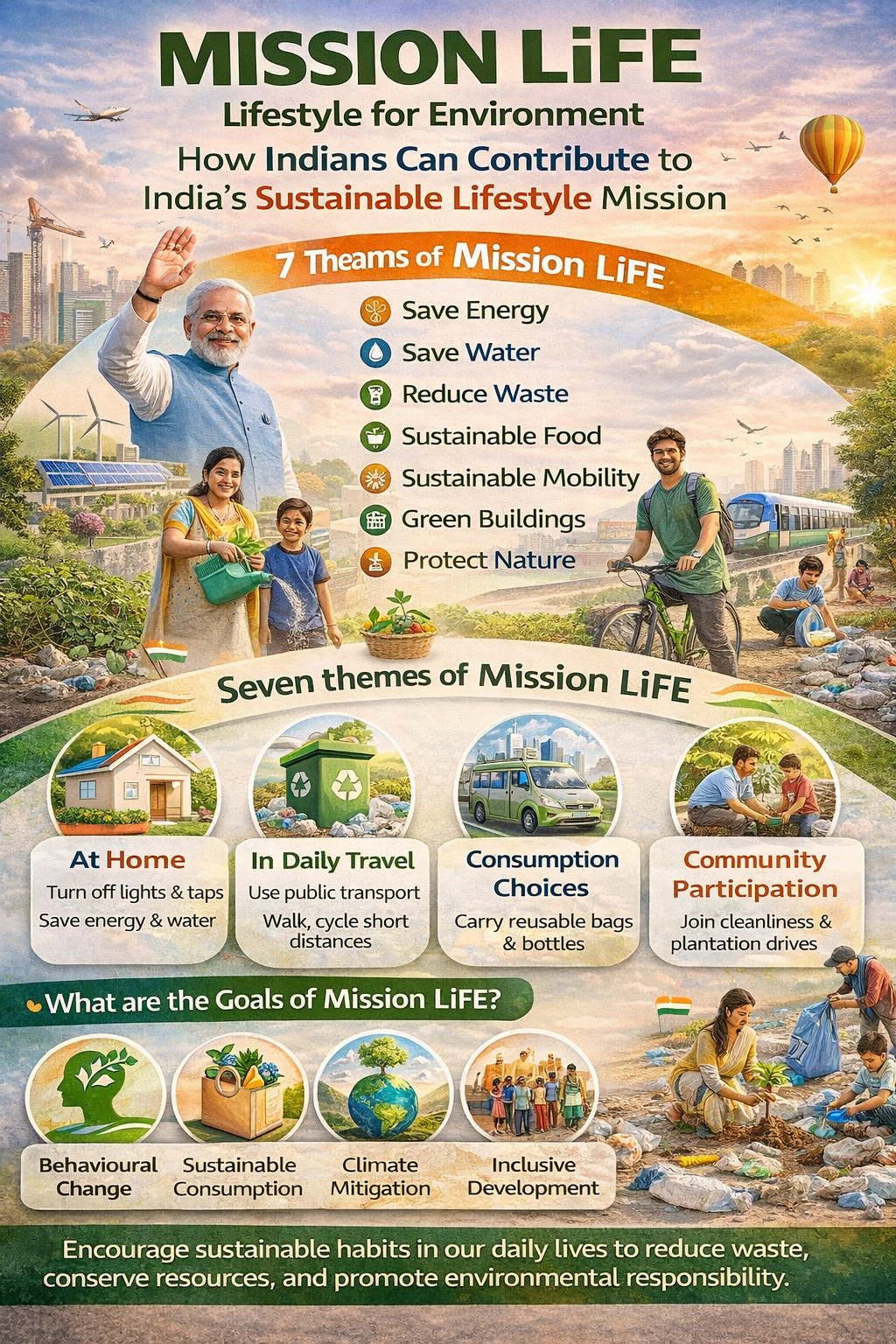
5. What Are the Goals of Mission LiFE?
Mission LiFE aims to achieve long-term environmental and social transformation by focusing on:
- Behavioural Change: Encouraging habits that reduce waste and emissions
- Sustainable Consumption: Minimising overuse of natural resources
- Climate Mitigation: Supporting India’s climate goals through lifestyle shifts
- Community Participation: Strengthening collective responsibility
- Inclusive Development: Ensuring sustainability benefits reach all sections of society
The mission aligns individual actions with national and global sustainability targets, creating shared accountability.
6. What Are the 7 Themes of Mission LiFE?
Mission LiFE operates around seven core themes that guide citizen action:
1. Save Energy
Promotes efficient electricity usage, renewable energy adoption, and reduced dependence on fossil fuels.
2. Save Water
Encourages water conservation through mindful usage, rainwater harvesting, and leak prevention.
3. Reduce Waste
Focuses on waste segregation, recycling, composting, and avoiding single-use plastics.
4. Sustainable Food Systems
Advocates reduced food waste, local sourcing, and balanced consumption patterns.
5. Sustainable Mobility
Supports public transport, walking, cycling, and shared mobility options.
6. Green Buildings and Homes
Encourages energy-efficient housing, natural lighting, and eco-friendly construction materials.
7. Protect Nature
Promotes biodiversity conservation, tree plantation, and ecosystem preservation.
These themes provide a practical framework for sustainable living.
7. Steps Taken by the Government of India for Sustainable Development
Mission LiFE complements several ongoing sustainability initiatives such as:
- Renewable energy expansion programs
- Swachh Bharat Mission for waste management
- Jal Jeevan Mission for water security
- National Electric Mobility Mission
- Afforestation and biodiversity conservation projects
The government supports Mission LiFE through policy integration, public awareness campaigns, digital platforms, and partnerships with educational institutions and civil society.
8. How Can Citizens Contribute to Mission LiFE?
Citizen participation is the foundation of Mission LiFE. Contributions can begin with simple daily actions:
At Home
- Switching off unused electrical appliances
- Using energy-efficient lighting
- Conserving water during household chores
- Practicing waste segregation
In Daily Travel
- Choosing public transport or carpooling
- Walking or cycling for short distances
- Supporting clean mobility options
Consumption Choices
- Avoiding unnecessary purchases
- Choosing durable and eco-friendly products
- Reducing food waste
Community Participation
- Joining local cleanliness drives
- Supporting tree plantation initiatives
- Spreading awareness within neighbourhoods
Every action, however small, contributes to the collective environmental goal.
9. Why Mission LiFE Is Important for India
India’s population size means individual behaviour has a significant cumulative impact on the environment. Mission LiFE ensures that development and environmental protection progress together.
The mission strengthens India’s position as a global climate leader while addressing local challenges such as pollution, water scarcity, and waste management.
10. Role of Communities, Institutions, and Youth
Educational institutions, workplaces, resident welfare associations, and youth groups play a critical role in amplifying Mission LiFE.
Schools and colleges can integrate sustainability practices, while workplaces can adopt green policies. Youth participation is particularly important as they influence long-term behavioural trends.
11. Long-Term Impact of Mission LiFE on India
Over time, Mission LiFE is expected to:
- Reduce environmental degradation
- Lower household resource costs
- Improve public health outcomes
- Strengthen climate resilience
- Build a culture of sustainability
The mission aims to make sustainable living a social norm rather than an exception.
12. Frequently Asked Questions
What is Mission LiFE by the Government of India?
Mission LiFE is a national movement promoting environmentally responsible lifestyles through citizen participation.
How can people contribute to Mission LiFE?
By adopting simple daily habits related to energy, water, waste, and consumption.
What are the goals of Mission LiFE?
To promote sustainability, reduce environmental impact, and encourage behavioural change.
What are the 7 themes of Mission LiFE?
Energy, water, waste, food systems, mobility, green buildings, and nature protection.
Why is Mission LiFE important?
It connects individual actions with national and global climate objectives.
13. Disclaimer
This article is intended for informational and educational purposes only. Details related to Mission LiFE initiatives, themes, and government actions may evolve over time. Readers are advised to refer to official Government of India sources for the latest updates and policy announcements.