Pradhan Mantri Kisan Urja Suraksha Evam Utthan Mahabhiyan (PM-KUSUM): A Comprehensive Guide for Indian Farmers
Table of Contents
- Introduction to PM-KUSUM
- What Is Pradhan Mantri Kisan Urja Suraksha Evam Utthan Mahabhiyan?
- Objectives of PM-KUSUM Yojana
- Key Components of PM-KUSUM Scheme
- How PM-KUSUM Supports Indian Farmers
- Eligibility Criteria for PM-KUSUM
- Subsidy Structure Under PM-KUSUM
- Environmental and Economic Impact
- Role of Renewable Energy in Indian Agriculture
- Challenges and Implementation Insights
- Frequently Asked Questions (FAQs)
- Conclusion
- Disclaimer
1. Introduction to PM-KUSUM
India’s agricultural sector is deeply dependent on energy for irrigation, crop production, and rural livelihoods. Recognizing the challenges of rising diesel costs, unreliable electricity supply, and environmental concerns, the Government of India introduced Pradhan Mantri Kisan Urja Suraksha Evam Utthan Mahabhiyan, commonly known as PM-KUSUM. This landmark initiative integrates renewable energy with agriculture, ensuring long-term sustainability and income stability for farmers.
2. What Is Pradhan Mantri Kisan Urja Suraksha Evam Utthan Mahabhiyan?
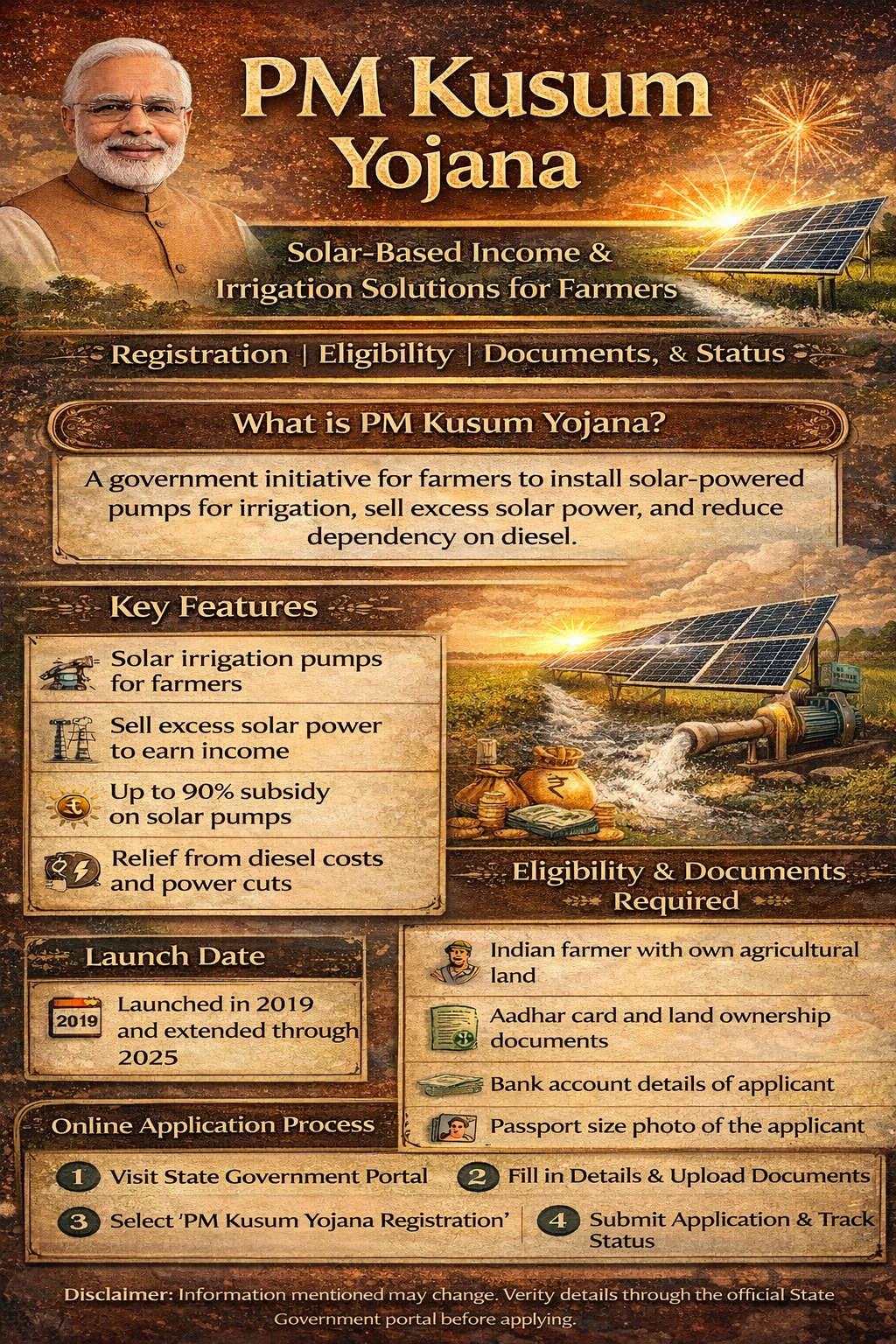
Pradhan Mantri Kisan Urja Suraksha Evam Utthan Mahabhiyan is a central government scheme launched to promote the use of solar energy in farming. The scheme aims to reduce dependence on diesel and conventional electricity while empowering farmers to become clean energy producers.
The initiative is implemented by the Ministry of New and Renewable Energy (MNRE) and focuses on decentralised solar power generation in rural areas.
3. Objectives of PM-KUSUM Yojana
The core objectives of Pradhan Mantri Kisan Urja Suraksha Evam Utthan Mahabhiyan include:
- Enhancing energy security for farmers
- Increasing farmer income through solar power generation
- Reducing diesel consumption in agriculture
- Promoting environmentally sustainable farming
- Supporting India’s renewable energy targets
This scheme aligns with India’s commitment to climate action and rural economic development.
4. Key Components of PM-KUSUM Scheme
PM-KUSUM consists of three major components, each addressing a specific agricultural energy need.
Component A: Decentralised Grid-Connected Solar Power Plants
- Installation of solar power plants up to 2 MW capacity
- Farmers can lease land or set up plants individually or in groups
- Power generated is sold to local DISCOMs
Component B: Standalone Solar Pumps
- Replacement of diesel-powered pumps with solar pumps
- Suitable for areas without grid electricity
- Ensures uninterrupted irrigation
Component C: Solarisation of Grid-Connected Pumps
- Existing electric pumps are connected to solar panels
- Excess electricity can be sold back to the grid
- Enables additional income for farmers
5. How PM-KUSUM Supports Indian Farmers
Pradhan Mantri Kisan Urja Suraksha Evam Utthan Mahabhiyan provides multi-dimensional support:
- Cost Savings: Reduced expenditure on diesel and electricity
- Income Generation: Sale of surplus solar power
- Reliable Irrigation: Solar pumps function even during power cuts
- Land Utilisation: Barren or unused land generates revenue
- Energy Independence: Farmers become energy producers
This approach transforms agriculture from a cost-intensive activity to a value-generating ecosystem.
6. Eligibility Criteria for PM-KUSUM
Eligibility requirements may vary slightly by state, but generally include:
- Applicant must be an Indian farmer
- Ownership or legal access to agricultural land
- Existing irrigation pump (for Component C)
- Willingness to install solar infrastructure
Farmer Producer Organisations (FPOs), cooperatives, and panchayats are also eligible under certain components.
7. Subsidy Structure Under PM-KUSUM
One of the most attractive aspects of PM-KUSUM is its subsidy model:
- Central Government Subsidy: Up to 30%
- State Government Subsidy: Up to 30%
- Farmer Contribution: Approximately 40% (can be financed through loans)
This structure ensures affordability and encourages widespread adoption.
8. Environmental and Economic Impact
Environmental Benefits
- Significant reduction in carbon emissions
- Lower groundwater over-extraction
- Promotion of clean and green energy
Economic Benefits
- Increased rural income
- Reduced dependence on fossil fuels
- Strengthened rural power infrastructure
Pradhan Mantri Kisan Urja Suraksha Evam Utthan Mahabhiyan supports both ecological balance and economic resilience.
9. Role of Renewable Energy in Indian Agriculture
Renewable energy is rapidly transforming Indian agriculture. Solar-powered irrigation ensures predictability, reduces operational costs, and mitigates risks caused by fuel price volatility.
PM-KUSUM acts as a catalyst for:
- Energy-efficient farming
- Climate-resilient agricultural practices
- Decentralised power generation
This marks a shift towards self-reliant rural energy systems.
10. Challenges and Implementation Insights
Despite its advantages, PM-KUSUM faces some challenges:
- Initial awareness gaps among farmers
- Delays in subsidy disbursement in certain regions
- Grid connectivity limitations in remote areas
However, continuous policy refinement and digital monitoring systems are improving implementation outcomes across states.
11. Frequently Asked Questions (FAQs)
What is the main purpose of PM-KUSUM?
To provide energy security, additional income, and sustainable irrigation solutions to farmers using solar power.
Can farmers earn income through this scheme?
Yes, surplus electricity generated can be sold to DISCOMs, creating an additional revenue stream.
Is PM-KUSUM applicable across India?
Yes, the scheme is implemented nationwide, with state-specific guidelines.
Does PM-KUSUM reduce diesel usage?
Yes, it significantly reduces reliance on diesel-powered pumps.
12. Conclusion
Pradhan Mantri Kisan Urja Suraksha Evam Utthan Mahabhiyan represents a transformational shift in India’s agricultural and energy policy. By integrating renewable energy with farming, the scheme empowers farmers economically, strengthens rural infrastructure, and supports national climate goals.
As India progresses towards sustainable development, PM-KUSUM stands as a powerful example of how policy innovation can uplift rural communities while protecting the environment.
Disclaimer
This article is intended for informational purposes only. Scheme details, eligibility conditions, and subsidy structures may vary by state and are subject to change by government authorities. For the most accurate and updated information, verification through official government portals or state renewable energy departments is recommended.